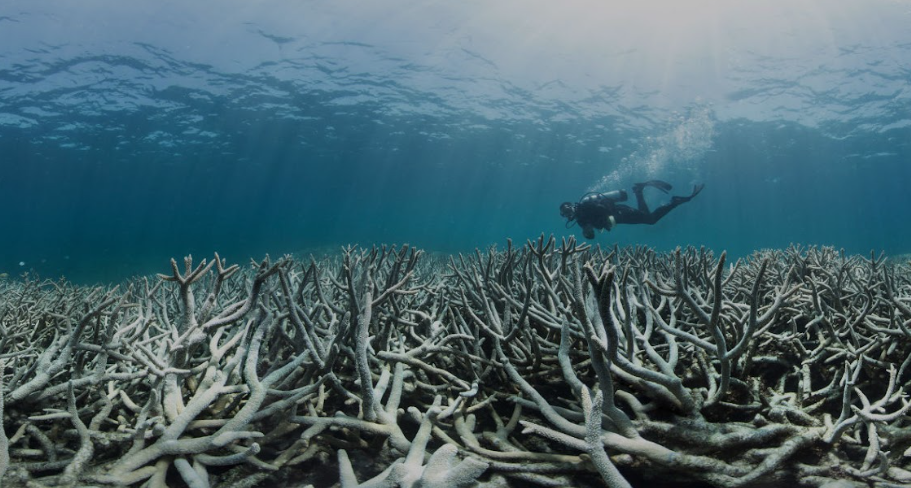
As a school of clownfish swim through the tropic water, they hover over skeletons. The once vibrant and colorful corals—home to millions of fish—are now stony, calcified structures that fish swim past in search for food.
As of Oct. 12, climate change has pushed coral reefs beyond what they can handle, and now they face a long-term decline that will affect the lives of millions of people, according to an article recently published by The Guardian.
Coral reefs thrive in water temperatures between 73 and 84 degrees Fahrenheit. Adapted corals can live in temperatures as low as 64 ℉ and as high as 95 ℉.
However, once corals experience a temperature increase of 2 ℉ or temperatures exceed 96 ℉, corals begin to bleach, the result of temperature, light or nutrients changing in their living conditions. Exposure to these temperatures for a sustained amount of time will result in the coral dying.
The National Ocean Service describes bleaching as corals being “stressed by changes in conditions such as temperature, light, or nutrients [and expelling] the symbiotic algae living in their tissues, causing them to turn completely white.”
Typically, healthy corals act as a habitat to the alga, zooxanthellae, commonly known as dinoflagellate. These algae give coral their bright colors. When water temperature increases, the dinoflagellates secrete harmful chemicals, causing the coral to expel them in order to survive. Due to the dinoflagellate leaving, coral lose their color and begin to bleach. Though bleached coral isn’t dead, they are at risk of starvation and vulnerable to diseases. If their surrounding water isn’t able to decrease in temperature, the coral will eventually die.
The Global Tipping Points Report 2025 (GTPR 2025), consisting of 160 researchers from countries such as the United States, Germany, the United Kingdom, Sweden, Netherlands, and Brazil reported that coral reefs have already passed their climate tipping point and are likely undergoing irreversible collapse.
If reports are true, there will be significant economical and environmental effects felt by people all around the globe.
Coral reefs have provided a cultural benefit, hosting as over 70 million# tourists every year who travel to snorkel around the colorful reefs. Cities with coral reefs are highly dependent on the tourism brought in from the reefs. With reefs bleaching and fish leaving those areas, tourists are losing the attraction and popular locations are losing visitors.
This could damage communities that rely on tourism such as Australia, home of the Great Barrier Reef. In Oct. 2025, the Great Barrier Reef Foundation reported that the Great Barrier Reef contributes $9 billion annually to Australia’s economy and is estimated to hold a value of $95 billion. Additionally, the reef is the equivalent of Australia’s fifth-largest employer, supporting 77,000 full-time jobs to local residents.
As reefs continue to die, the fish reliant on corals will continue to change. Fish capable of living independently will migrate to a new habitat while those incapable of being away from reefs will shrink in populations.
Fish such as coral trout and saddletail snappers may not be so lucky. A study reported by Oceanographic shares that a change from 30% live coral in the Great Barrier Reef to 25% coral would decrease Ccoral ttrout populations by 8% and saddletail snapper populations by 19%. If the situation worsens, a change of live coral from 10% to 5% would decrease coral trout populations by 27% and saddletail snapper populations by 56%.
As fish levels fall, fisheries will decrease in increasingly get smaller and lead to smaller commercial yields, affecting the food we eat. According to Coral Vita, over 500 million people depend on reef fisheries, whether it be through food security or job income.
Additionally, a decrease of product brought in from the fishing economy will put pressure on agriculture to fill in the gap left by the lack of fish. A higher demand for traditional meat and crops will occur, requiring more water, resources, and land.
Aside from food, coral reefs act as a barrier and protect many from natural disasters. Scientists from the University of California – Santa Cruz, the U.S. Geological Survey, and the Nature Conservancy found that coral reefs protect over 18,000 Americans and $1.8 billion worth of coastal infrastructure. They’re especially helpful in protecting populations that are vulnerable, under served, and underrepresented.
In addition, humans gain medical treatments from coral reefs. Chemical compounds found in coral are used to develop treatments for diseases such as cancer, common viruses, and bacterial infections. These compounds are also used to develop pain relief medications. With the loss of coral, scientists will have to find alternative ways to make treatments for patients.
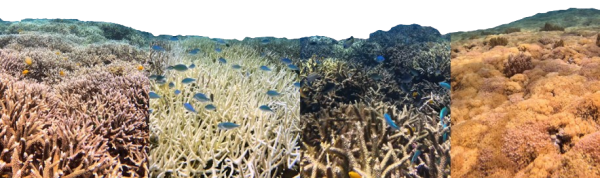
Coral reefs aren’t the only ecosystems who are reaching their limit to withstand their changing environment. The GTPR 2025 reported that the ecosystems closest to tipping aside from coral reefs include the Greenland ice sheet, West Antarctic ice sheet, permafrost, and the Subpolar gyre.
The Arctic regions in as Russia, Canada, Alaska and Greenland have greatly suffered from the increased Earth temperatures. As more and more ice has melted, more permafrost has slowly been revealed more and more. Permafrost is permanently frozen ground that has been continuously frozen for at least two consecutive years below 32 degrees Fahrenheit. Carbon that has been stored for thousands of years within the permafrost is emitted into the atmosphere as it melts.
In addition to permafrost, ice sheets in Greenland and the West Antarctic are also melting. Since the 90s, ice loss in these regions have significantly accelerated due to increased temperature (Live Science). As more ice is melting, water levels are increasing. This will affect coastal communities including those on California’s central coast.
Furthermore, coral reefs aren’t the only parts of the ocean undergoing change.
Gyres are large, circular systems of ocean currents that rotate water throughout the different oceans. Gyres are crucial for the distribution of heat, assuring that the oceans don’t experience extreme temperatures. Additionally, gyres distribute nutrients throughout the oceans, supporting marine ecosystems. As global temperatures continue to increase, ocean water density decreases and speeds up the movement of gyres. This slows the global ocean conveyor belt, a circulation within the oceans that transports heat and nutrients at different depths in the oceans. A slower global ocean conveyor belt will limit the nutrients made available to marine life.
Beyond ice, The Amazon Rainforest has long been known for its ability to take carbon dioxide out of the atmosphere and turn it into oxygen for humans to breathe through the process of photosynthesis. However, a 2021 story published by Nature found that due to human activities such as controlled fires to implement agriculture and industrial land, the Amazon is now releasing more carbon dioxide into the atmosphere than removing. There is much speculation about the final state of the Amazon if it surpasses its tipping point, but many believe it could turn into a dry, empty savannah.
Though it may seem that saving the planet is futile, scientists beg to differ.
Some organizations have begun to grow selectively bred corals, meaning they take heat or stress-tolerant corals and breed them in order to produce stronger and more resilient offspring. This allows future coral reefs to be built out of corals that can handle the warmer oceans.
However, a problem this solution may face is the continuation of warming oceans. Coral may be tolerant to current ocean temperatures, but may not be tolerant to the temperature of oceans in the future.
As climate change continues to become a more prevalent issue, scientists continue to research ways to adapt to the Earth’s new normal.