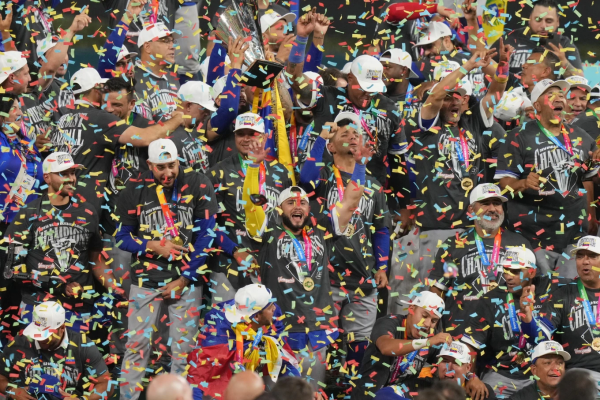
Taking down the previous championship finalist United States and the previous champion Japan during their run, Venezuela earned the title of world champions on Mar. 17, 2026 in Miami, Florida at LoanDepot Park.
Created by Major League Baseball (MLB) in 2006 as a way to promote global baseball and increase the sport’s international exposure, the World Baseball Classic is often called “baseball’s World Cup.” The tournament is typically held every three to four years, and features some of the top baseball talent in the world.
TEAMS
There are 20 teams making up the tournament, coming from all over the world. Some of the top teams come from the United States, Japan, Dominican Republic, Venezuela, and Mexico (MLB on FOX). Top tournament players include Japan’s Shohei Ohtani, the Dominican Republic’s Juan Soto, and the USA’s Aaron Judge, Bobby Witt Jr., and Cal Raleigh (MLB on FOX).
View full team rosters below:
TOURNAMENT IMPORTANCE
Aside from monetary gains, the tournament also aims to promote baseball globally while acting as a true “world championship” that, similar to the Olympics and the World Cup, evokes national pride among citizens, regardless of investment or interest.
“I think that whether you watch sports or not, you kind of do have a bit of an association with that [country’s] sports team, because they do represent you,” varsity baseball player and junior Casey Prieto said. “Baseball is a game that should be enjoyed everywhere, regardless of where you’re from or what other sports your country is typically associated with. So at the very least, I think that people who normally don’t watch baseball should just watch it for the culture at least.”
Prieto hopes that in the near future, the tournament will be more competitive with more countries being represented as the sport continues to grow. “More people hopefully get the opportunity to get the training and just get the chance to play the sport.”
TOURNAMENT LAYOUT
Pool play began on Mar. 5 in Tokyo, Japan. Teams are divided into four pools containing five teams each. The pools have been made with balanced competition levels to allow for fair play and maximizing both geographic and commercial interest in mind. A combination of host country assignments, previous tournament performances, and world rankings were taken into account to determine grouping, seeding, and matchups.
Teams played the other four teams in their pool once each in a round-robin style tournament. The top two teams in each pool would move on to the quarterfinals.
One important rule to note is the inclusion of a mercy rule. A game will end prematurely if a team is leading by 15+ runs after the fifth inning or if a team is leading by 10+ runs after the seventh inning, though these rules are dropped for semifinals games and the championship.
POOL PLAY
Pool A consisting of Canada, Colombia, Cuba, Panama, and Puerto Rico began play on Mar. 6 as Cuba took down Panama by a score of 3-1 in San Juan, Puerto Rico at Hiram Bithorn Stadium off the backs of Yoelkis Guibert and Yoán Moncada who both hit home runs as well as pitchers Livan Moinelo and Yariel Rodríguez. Later in the day, Puerto Rico defeated Colombia 5-0.
Pool B consisting of Brazil, Great Britain, Italy, Mexico, and the United States began play on Mar. 6th as Mexico took down Great Britain by a score of 8-2 in Houston, Texas at Daikin Park with the help of Nacho Alvarez Jr. and Jonathan Aranda who both hit home runs. Later in the day, the United States defeated Brazil 15-5.
Pool C consisting of Australia, Chinese Taipei, Czechia, Japan, and Korea began play on Mar. 5 as Japan took down Chinese Taipei by a score of 13-0 in Tokyo, Japan at the Tokyo Dome that included a grand slam from Shohei Ohtani and a shutout from pitcher Yoshinobu Yamamoto. Later in the day, Chinese Taipei played once again and this time defeated Czechia 14-0.
Pool D consisting of the Dominican Republic, Israel, Netherlands, Nicaragua, and Venezuela began play on Mar. 6 as Venezuela took down Netherlands by a score of 6-2 in Miami, Florida at LoanDepot Park thanks to runs batted in (RBIs) from Luis Arraez and Willson Contreras. Later in the day, the Dominican Republic defeated Nicaragua 12-3.
As pool play concluded, Canada topped Pool A and advanced to their first ever quarterfinals after an unexpected 3-1 run with Puerto Rico right behind them moving on to the quarterfinals. One of the more stunning finishes was Cuba, finishing 2-2 and not making it out of pool play after being one of top teams entering the tournament. Though both countries finished 1-3, Panama and Colombia remained competitive, looking to prove themselves in the next tournament.
One of the biggest surprises of the tournament, Italy topped Pool B with a 4-0 run that included an upset victory over the United States, who also barely finished second in the pool thanks to Italy beating Mexico in the final game of pool play. Mexico performed well, but failed to execute on the final day. Scores may indicate otherwise, but Great Britain was able to stay mostly competitive throughout pool play when playing against juggernaut countries. And even with a 0-4 finish in their first ever World Baseball Classic appearance since 2013, Brazil showed promise for the future with rising stars making themselves known to the baseball world, including 17 year-old pitcher Joseph Contreras who was able to get out of a jam (tough pitching situation) against of the United States’ top players, Aaron Judge.
Unsurprising to many, Japan topped pool C with a 4-0 run, though it wasn’t as smooth as they were expecting with trouble from Australia, Korea, and Czechia electrician turned pitcher Ondrej Satoria. Korea was able to secure second place, finishing 2-2, and move onto the quarterfinals after a final win over Australia gave Korea the tiebreakers over Australia and Chinese Taipei. As mentioned, Australia and Chinese Taipei failed to advance, but both teams remained competitive and were some of the more exciting teams to watch throughout the tournament. Czechia once again wasn’t able to move on to the next round like in 2023, but at the same time they were able to bring a competitive team that fought to the end.
In one of the most exciting games of the tournament that saw the Dominican Republic and Venezuela fighting for a 4-0 finish and the top spot of Pool D, the Dominican Republic was able to emerge victorious as Venezuela still moved on to the quarterfinals. Though the pool was dominated by the two countries and was one of the least competitive pools, Israel was able to stay competitive as they watched the aging Netherlands struggle alongside Nicaragua who went 0-4 again in only their second tournament appearance, putting them at an 0-8 record all time in the World Baseball Classic.
QUARTERFINALS
Kicking off the quarterfinals was the Dominican Republic’s dominating win over Korea in Miami on Mar. 13 off the backs of Cristopher Sanchez’s five shutout innings (innings with no runs given up). In addition to the Dominican Republic’s domination on the mound, a combination of singles, walks, RBI groundouts, doubles, and sacrifice flies (a batter hitting a fly ball that is caught but allows a runner to score) put the Dominican Republic up 7-0 before Austin Wells’ three-run homer in the seventh inning gave the Dominican Republic a 10-0 lead, ending the game prematurely due to the tournament’s mercy rule.
On the same day in Houston, the United States took on neighbor Canada, who came into the game looking to break the streak of U.S. sports wins over Canada in 2026 that included the United States Women’s National Soccer Team beating Canada in the SheBelieves Cup only 9 days prior, the United States’ women’s hockey team beating Canada in the hockey Olympic group stage before eventually winning gold in Italy in February, and the United States’ men’s hockey team beating Canada in the Olympic finals to win gold on Feb. 22, 2026. The United States slowly chipped away at Canada’s pitchers as an RBI groundout and three RBI singles would give the U.S. a 5-0 lead in the sixth inning. The same inning, Canada would strike with their own RBI single before a two-run homer from Bo Naylor would cut the United States’ lead to two runs. David Bednar came in to prevent Canada from scoring any additional runs before two shutout innings from Garrett Whitlock and Mason Miller sealed Canada’s fate. Two days later on Mar. 15, 2026, the United States’ paralympic team would defeat Canada in the sled hockey finals of the Winter Paralympics, securing yet another U.S. victory over Canada.
The second half of quarterfinals began on Mar. 14, 2026 as Italy looked to continue their historic run against Puerto Rico. Puerto Rico quickly took the lead with a leadoff home run from Willi Castro in the first inning. Italy responded with three RBI singles and a sacrifice fly to give them an early 4-1 lead. A bases-loaded walk in the next inning allowed Puerto Rico to cut Italy’s lead in half, but two back-to-back doubles from Andrew Fischer and J.J. D’Orazio in the fourth inning extended Italy’s lead to 8-2. It wasn’t until the eighth inning that Puerto Rico began a comeback attempt thanks to an RBI force out from Eddie Rosario, a wild pitch from Italy’s Joe La Sorsa that allowed Emmanuel Rivera of Puerto Rico to score, and a Christian Vazquez single that scored two more runs, bringing the score to 8-6 in Italy’s favor. Greg Weissert came in for Italy to get out of the inning and limit the damage done by Puerto Rico. He then prevented Puerto Rico from scoring any runs in the ninth inning, securing Italy’s spot in the semifinals.
In the final quarterfinal game of the 2026 tournament, the red hot Venezuela took on defending champion Japan. On only the second pitch of the game, Ronald Acuna Jr. hit a leadoff homer to give Venezuela a temporary 1-0 lead before Japan’s Shohei Ohtani returned the favor with a leadoff home run of his own the same inning, tying the game at 1-1 before fans had finished settling into their seats. In the second inning, Venezuela’s Gleyber Torres would hit an RBI double to regain the lead. Japan wouldn’t respond until the third inning with a double by Teruaki Sato tied the game with Shota Morishita immediately hitting a three-run home run to give Japan a 5-3 lead. A two-run home run from Venezuela’s Maikel Garcia in the fifth inning and a three-run home run from Wilyer Abreu in the sixth inning put Venezuela up 7-5 and in the driver’s seat to take down the reigning champions. Shutout pitching from Angel Zerpa, Andres Machado, and Daniel Palencia kept Japan’s slugging lineup at bay as a failed Japanese pickoff attempt (a pitcher throwing a live ball in an attempt to tag out a runner on already base) gave Venezuela some extra padding to their lead, now 8-5, in the eighth inning before a Shohei Ohtani fly out ended Japan’s hopes of repeating as champions.
SEMIFINALS
The first game of the semifinals began with a battle between the United States and the Dominican Republic. Both teams came into the game with arguably two of the best lineups in the whole tournament, and fans were expecting a high scoring game that would be remembered for many years to come. Though a high number of scoring was predicted, it wasn’t until the second inning that Junior Caminero hit a solo home run off of U.S. pitcher Paul Skenes, giving the Dominican Republic a 1-0 lead. The United States didn’t respond until the fourth inning, when Gunnar Henderson hit a solo home run off of the Dominican Republic’s Luis Severino who ended his night a batter later. His replacement Gregory Soto only threw six pitches before giving up another solo home run to Roman Anthony as the U.S. took a 2-1 lead. Throughout the rest of the game, six U.S. and five Dominican pitchers combined to only give up seven total hits as the United States’ Mason Miller struck out Geraldo Perdomo to send the U.S. to their third straight World Baseball Classic final appearance.
Looking to end Italy’s Cinderella run, Venezuela came in hot after their win over Japan. Like the U.S. versus the Dominican Republic, the game remained scoreless until the second inning when an RBI walk from J.J. D’Orazio and an RBI forceout put Italy up 2-0. Italy pitcher Aaron Nola kept a clean sheet until a Eugenio Suarez solo home run put Venezuela on the board. Luinder Avila took the mound for Venezuela and held Italy to only two hits, allowing Venezuela to come up with an eclectic seventh inning that included three RBI singles, putting Venezuela up 4-2. Shutout innings from Eduard Bazardo, Andres Machado, and Daniel Palencia helped Venezuela seal their win and first ever World Baseball Classic final appearance.
CHAMPIONSHIP
Coming into the game, the main story was Venezuela’s passionate run to win their first championship versus the United States’ disciplined quest to win their second World Baseball Championship. It was Venezuela who struck first after a Maikel Garcia sacrifice fly put them up 1-0. A Wilyer Abreu home run in the fifth inning extended Venezuela’s lead to two runs. Venezuelan pitchers Eduardo Rodriguez, Eduard Bazardo, Jose Butto, and Angel Zerpa held the U.S. team to only two hits until a Bryce Harper two-run home run off of Andres Machado in the eighth inning tied the game at 2-2. After a walk from Venezuelan Luis Arraez, Javier Sanoja took his place as a pinch runner (substituting a runner on base) and immediately stole second base (a baserunner advancing to second base while the pitch is being thrown). Eugenio Suarez hit a double, scoring Javier Sanoja and once again giving Venezuela the lead. Going into the bottom of the ninth inning, Venezuela gave Daniel Palencia the mound to face the heart of the United States’ order, Kyle Schwarber, Gunnar Henderson pinch hitting (substituting a batter) for Alex Bregman, and Roman Anthony. All throughout the tournament, the United States’ had been plagued by poor hitting, and it was no more visible than the final inning as Kyle Schwarber struck out, Gunnar Henderson popped out, and Roman Anthony struck out as Venezuela took home their first World Baseball Classic championship.
CONCLUSION
Following a stellar tournament performance, Venezuela was able to earn their first ever World Baseball Classic win, cementing baseball as the country’s sport; the United States once again failed to deliver in the championship game, even after they brought one of the most hyped up teams in the country’s history; Japan will look to regroup after a surprising early exit; though the Dominican Republic were one of the best of the tournament, they’re surely be looking to come back stronger after a disappointing loss in the semifinals; it’s unknown if Italy will be able to return to form in the next tournament, but they’ve moved themselves into conversation for baseball’s best country.
Following World Baseball Classic rules regarding teams finishing last place in pool play having to requalify for the following tournament, Panama, Brazil, Czechia, and Nicaragua will be looking to qualify and return to the tournament in the future.