Most years when you’d walk into one of Taylor Brooks’ animation classes, you’re greeted with a bunch of little groups working on their own individual animations. However, this year’s three animation classes are doing something different: banding together to create one single animation.

“Last year, smaller groups just didn’t work out. We had smaller groups of four or five or so, and they were only supposed to be five minute animations, but we never really got any of them done,” senior Gavin Cheney said, the animation’s assistant director.
The long-form animation follows a girl who starts working at a robot laboratory where she finds a robot being tortured. She frees the robot and they fight together to fight off the evil CEO. The story was formed through a mad libs type style, where each person in Colors of Animation, the second year animation class, created a simple frame of a scenario, and after completion, the final story was made by combining all of the frames into a single story.

“Mr. Brooks actually kind of just said you guys look like good leaders and just gave it to us,” Cheney said when explaining the director process. The animation classes work under a hierarchical system. At the top is senior Ruth Schulte, the scriptwriter and main director of the animation and under her is Cheney the assistant director as mentioned before. They’re also what are called operators, a group of animation veterans usually in Colors of Animation, the second year animation class, that serve to monitor the rank under them, laborers. These laborers, as their name suggests, do most of the actual animating and they mostly consist of people in Foundations of Animation, the first year animation class.
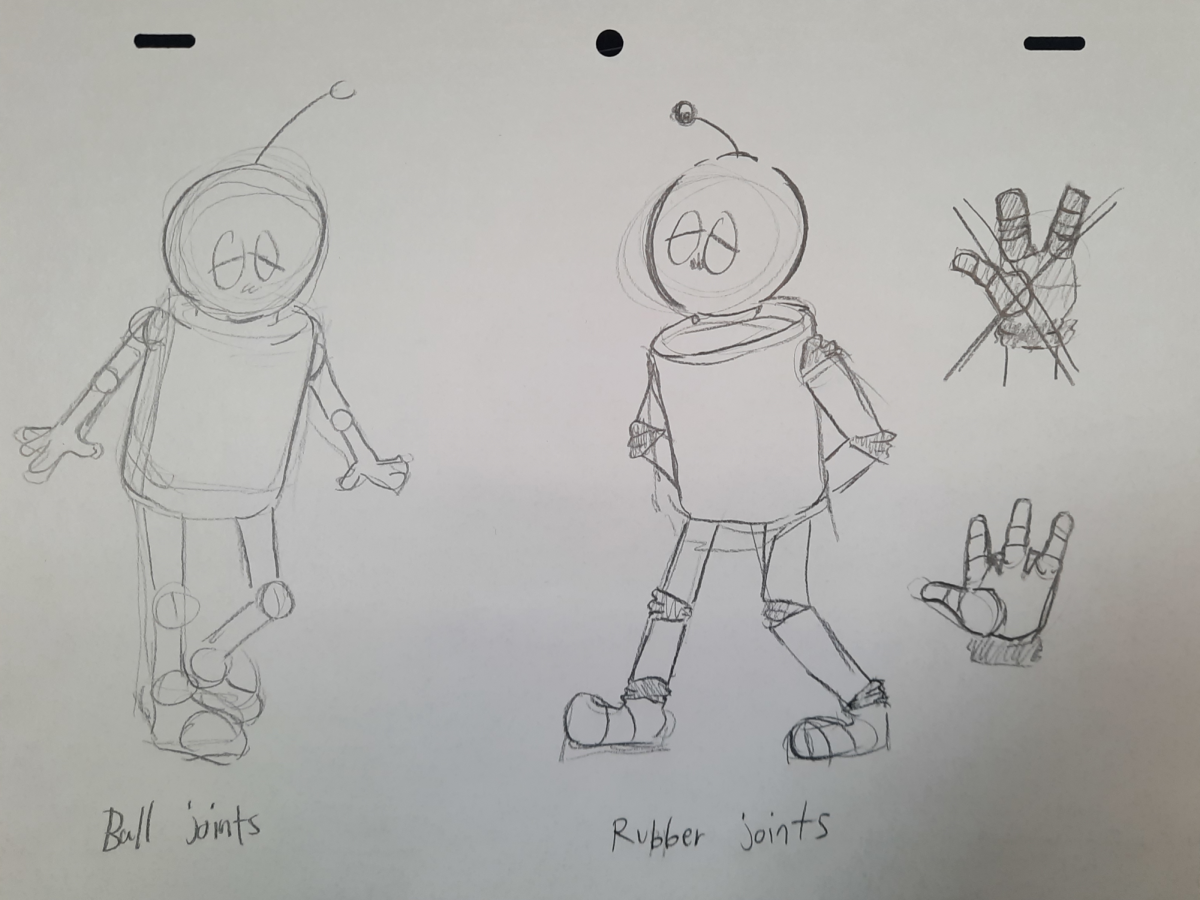
The first part of making an animation is, of course, the script. The script was written by Schulte, the main director. That is then given to the character designers, who figure out the design of all the characters for future reference, creating what are called reference sheets that are later used as the name would imply, for reference. The script and reference sheets are given to storyboard artists that plot out the background and sparse frames, mapping out the general story visually. Then these are given to keyframe artists and background artists, the latter working on, of course, backgrounds. While the former make keyframes, which are essentially the major poses for the animation. Those keyframes are then handed to the laborers who take the keyframes and animate the frames between the keyframes, creating the actual animation. These are then composited over the backgrounds with sound effects and other audio being added on top after.
Schulte said that they’re working on the animation in sections. Such as the first section being the dinosaurs in the intro sequence that are used to start the overall theme of “life goes on”. Since the pipeline is fairly linear this is what was found to work best as it allows all levels of artists to be working at the same time, as compared to each level doing work individually.
A big reason for how much time it takes to produce an animation is their traditional method of drawing frames on paper individually as mentioned earlier. This process, called Onion Skinning, is how old Disney movies were made, such as Snow White and the Seven Dwarfs (1937) and The Lion King (1994). Of course even digital 2d animation takes a long take as well. As for both you’re effectively making around 12 or 24 drawings for every second, with the animation being in 12 frames per second in order to speed up the animating process.
Everyone has seen an animation at some point, whether it’s their favorite childhood movies or something you see online. But it’s important to remember how much work goes into every animation you see, the animators that all spent a long time perfecting their animation for it to be released to the world either commercially or simply for the fun of making art.